BEIJING, Oct. 9, 2026 /PRNewswire/ -- IQuest-Q1 has drawn early praise from developers and industry watchers since launch, particularly for its performance on coding, software engineering, interactive application generation, and long-horizon agentic workloads.
The model weights and technical materials are publicly available:
- GitHub — GitHub - IQuestLab/IQuest-Q1
- Hugging Face — https://huggingface.co/IQuestLab/IQuest-Q1
- Blog — https://iquestlab.github.io/
IQuest-Q1 is trained for the work developers actually do: navigating a repository, driving a terminal, calling tools, holding a long context in mind, and finishing multi-step tasks without losing the thread. Reasoning, tool use, long-context understanding, and multi-step execution were part of the training objective from the start — not adapted afterward.
Early external discussion has begun to explore IQuest-Q1's capabilities. One highlighted its evaluation across application building, 3D spatial generation, code diagnosis and repair, and complex tool-assisted workflows, while another publicly shared use case described turning a written product brief into an interactive SaaS analytics dashboard. A third-party technical overview examined the sparse Mixture-of-Experts architecture, integration with Claude Code and Codex CLI, and the infrastructure requirements of self-hosting a 320B-parameter model.
These early observations align with IQuest Research's official demonstrations, which show IQuest-Q1 working across interactive application generation, code debugging, and multi-step tool use.
One-shot interactive applications
From a natural-language prompt, IQuest-Q1 emits runnable interactive apps in a single pass.
An FPS game. In one generation, the model produces the 3D scene, character movement, health, scoring, mode switching, and an in-game shop for resources and gear — code, file layout, interaction logic, and visuals in the same pass.
A racing game. Continuous scene extension — track geometry, foreground/background transitions — is where one-shot generations usually fall apart. IQuest-Q1 handles this class of spatially continuous, interaction-heavy app without special prompting.
Debugging a real RL run
IQuest-Q1 will also drop into an existing codebase and training stack and fix what's actually wrong.
An RL run went off the rails. Starting from the training curves, the model pulled logs and execution traces, reasoned back through likely causes, and localized the bug in code. After the patch and a restart, it read the new metrics and confirmed recovery.
The root cause: a stray space had been inserted into the training trajectory. Removed, metrics came back up.
Multi-step work in a real environment
Given a workspace with heterogeneous information and tools, IQuest-Q1 runs multi-step tasks — reading, calling tools, and correcting itself as new information lands. In office settings it works across chat, cloud docs, spreadsheets, and comment threads, pulling context together into analysis, drafts, and revisions that are ready to hand off.
Architecture
The architecture and training approach behind these capabilities are outlined below.
Decoder-only Transformer with a sparse Mixture-of-Experts feed-forward. ~320B total parameters, ~15B active per token.
Training runs in three stages — pre-training, mid-training, post-training — bringing up code fluency first, then extending into longer, harder tasks.
Post-training focuses on software engineering, long-horizon agentic tasks, and general reasoning, using supervised fine-tuning and reinforcement learning. On top of that, Multi-Teacher On-Policy Distillation (MOPD) consolidates strengths from several teachers on the student's own on-policy rollouts, so the student picks up capability without inheriting any one teacher's bias profile.
Validated updates, datasets, and workflows feed into the next iteration. Pipelines, training configs, eval harnesses, and tooling are versioned and reused — capability work and infrastructure work compound instead of getting rebuilt each cycle.
Evaluations
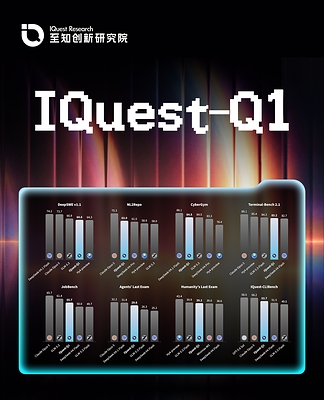
IQuest-Q1 posts balanced results across benchmarks covering code, software engineering, terminal use, tool use, and agentic tasks:
- NL2Repo — repository-level code generation
- CyberGym — cybersecurity
- Terminal-Bench 2.1 — terminal operation
- DeepSWE v1.1 — long-horizon coding
- JobBench — professional office workflows
Full numbers, baselines, and evaluation setup are in the technical report.
IQuest-Q1 was developed by IQuest Research. Developers and research teams interested in participating in upcoming early-access testing programs can apply for trial access via email: research@iquestlab.com
CONTACT:
IQuest Research
research@iquestlab.com
 View original content to download multimedia:https://www.prnewswire.com/apac/news-releases/iquest-q1-draws-early-developer-attention-across-coding-and-agentic-workflows-302903253.html
SOURCE IQuest Research


