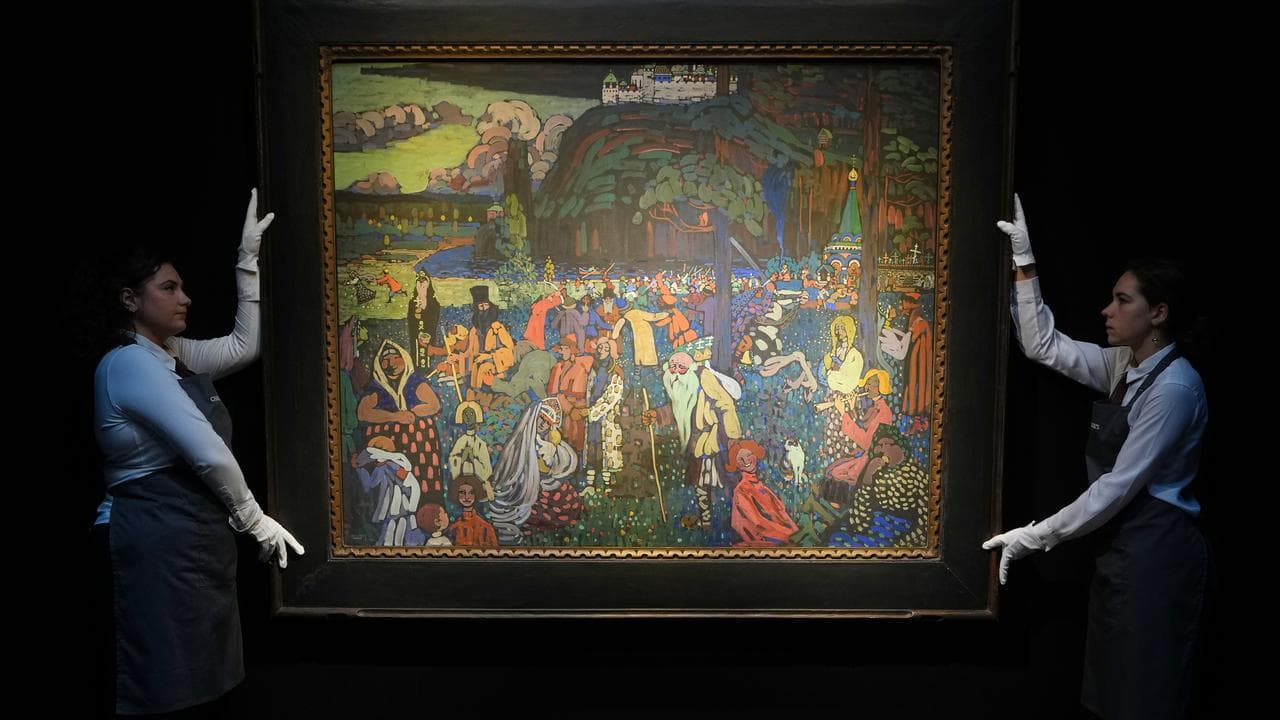
Wassily Kandinsky's painting The Colorful Life has sold for STG27 million ($A51 million) at auction in London.
The 1907 painting had hung for decades in Munich's Lenbachhaus museum before being classified as Nazi-looted art in 2023 and returned to the heirs of the Jewish collector family Lewenstein.
Keith Gill of Christie's 20th and 21st century art department said The Colorful Life was a seminal work that captures the development of Kandinsky's formal language and anticipates the extraordinary change in his style in the years that followed.
Gill added the painting was deeply connected to the cultural traditions of Kandinsky's homeland, Russia.
The Colorful Life, with old Russian motifs and fairytale figures, was painted by Kandinsky (1866-1944) during his time in Paris, under the influence of styles such as Fauvism, Symbolism and Art Nouveau.
According to Christie's, the painting was also exhibited at the Paris Salon d'Automne (Autumn Salon) in 1907. To this day it is regarded as a key work in Kandinsky's oeuvre.
In 1927, the Amsterdam collector couple Lewenstein acquired the canvas. After the death of her husband, Emanuel Albert Lewenstein (1870-1930), his widow Hedwig Lewenstein-Weyermann (1875-1937) lent the tempera painting to the Stedelijk Museum as a permanent loan.
After German forces occupied the Netherlands, the work was auctioned in October 1940. According to Christie's, the collector Salomon B Slijper won the bid and his family sold it in 1972 to the Bavarian State Bank (Bayern LB), which handed it over to the Lenbachhaus as a permanent loan in 1973.
What followed was a years-long battle by the Lewenstein heirs. They regarded the October 1940 auction as an injustice and demanded restitution. Their argument was the family had placed the painting with a museum in Amsterdam for safekeeping in 1938, before fleeing to the United States from the Nazis. It was then sold without permission.
Provenance research ultimately sided with the family. There was a lack of evidence they had handed the painting over to the auction house in 1940 of their own free will, the Advisory Commission on Nazi-looted art found.
Bavaria's state parliament approved the painting's return in 2023.


