What was claimed
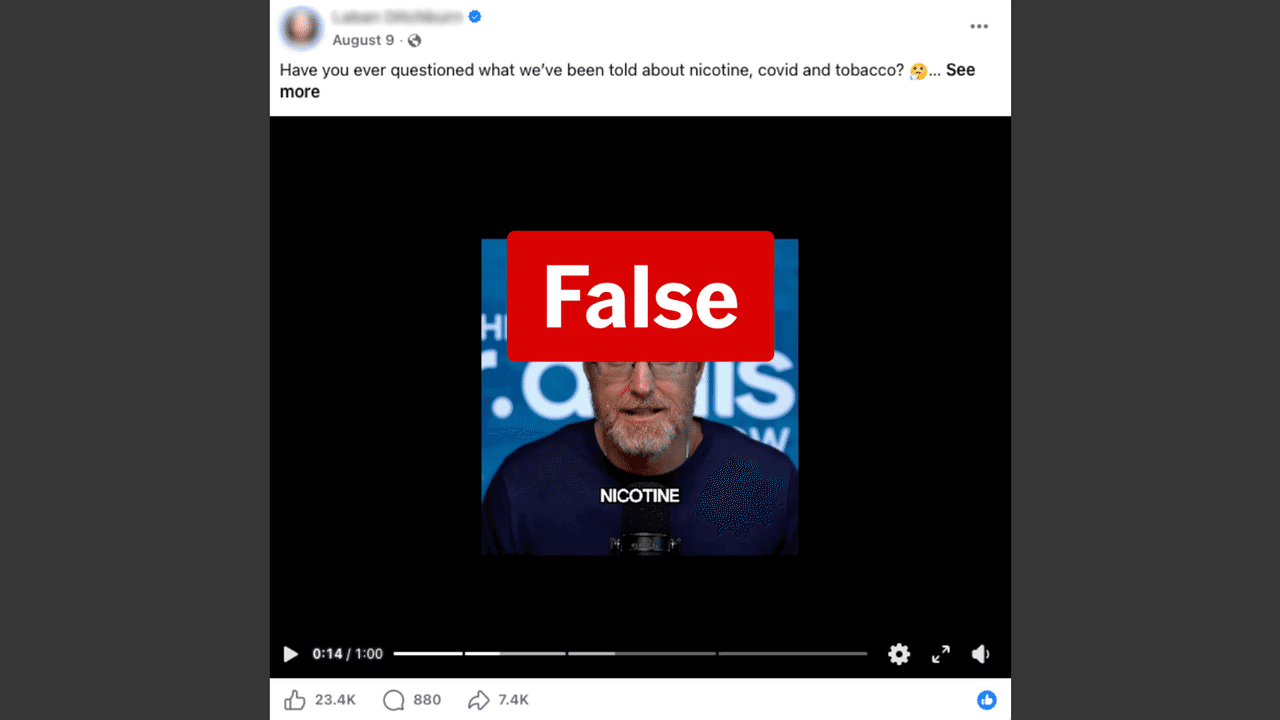
Beta cells in the pancreas need nicotine to activate and release insulin.
Our verdict
False. Beta cells do not require nicotine to release insulin, and smoking is a risk factor for diabetes.
AAP FACTCHECK - A viral Facebook post claims nicotine is required for the body’s insulin-producing cells to function properly and suggests a lack of nicotine can cause diabetes, but that’s untrue.
Conversely, research has found nicotine can inhibit the body's ability to produce insulin, and smoking is a known risk factor for type 2 diabetes.
The claim appears in an August 9 Facebook video that has been viewed more than one million times.
"Did you know that every beta cell in the pancreas that produces insulin needs nicotine to activate those cells to release the insulin," a man in the video says.
"And if you don’t have nicotine in your body to do that, you’ll be insulin dependent, which is what type 1 diabetics are."
Beta cells in the pancreas produce and release the hormone insulin, which helps the body absorb sugar from the bloodstream.
But while beta cells have receptors that respond to nicotine, research has found the drug impairs insulin secretion, and experts told AAP FactCheck the claim is wrong.
Type 1 diabetes, once called insulin-dependent diabetes, occurs when the immune system attacks beta cells, resulting in little or no insulin production.
The condition requires daily insulin treatment.
Research examining nicotine's effect on beta cells has mostly found the drug has a negative rather than a positive effect on insulin secretion.
Bernie Tuch, a diabetes researcher and founding director of the Australian Foundation for Diabetes Research, said nicotine binds to certain beta cell receptors but does not stimulate insulin secretion.
"Indeed, nicotine disrupts the intracellular signalling that triggers insulin release," Professor Tuch told AAP FactCheck.
Prof Tuch said nicotine was instead a risk factor for type 2 diabetes.
Type 2 diabetes occurs when the body becomes resistant to insulin, leading to insufficient insulin production.
"Chronic nicotine exposure tends to blunt glucose-stimulated insulin secretion, resulting in increased insulin resistance and the development of type 2 diabetes," Prof Tuch said.

Prof Tuch referred AAP FactCheck to a 2025 paper published in the journal Diabetes, which examined nicotine's effects on pancreatic cells and found the drug did not stimulate insulin secretion.
Christopher Nolan, a diabetes expert at Australian National University, described the claim in the Facebook video as "seriously disturbing misinformation".
Nicotine was not required for beta cells to secrete insulin, Professor Nolan told AAP FactCheck.
He cited a 2020 laboratory study, published in the journal Toxicology, that found nicotine could negatively affect beta cells, causing them to age more rapidly.
"[That's] the absolute opposite to that suggested in the video," he said.
Smoking also increased the risk of diabetes and was a major factor exacerbating diabetes complications, Prof Nolan said.
A 2017 review study found smoking was linked with an increased risk of type 2 diabetes.
The 2017 review detailed a 2013 study of 1199 Japanese men that found smokers were twice as likely as non-smokers to have impaired insulin secretion, and higher smoking rates were linked to greater impairment.

"Clinical data suggest an effect of smoking and nicotine on body composition, insulin sensitivity, and pancreatic beta cell function," the 2017 paper concluded.
A 2023 World Health Organization briefing on tobacco and diabetes also said nicotine impaired the function of beta cells, which affected insulin production and played "an important role in the onset of type 2 diabetes" (page 2).
Isabella Artner, who studies pancreatic cells at Lund University in Sweden and co-authored a 2016 study examining how nicotine affects beta cells, also said beta cells do not depend on nicotine.
"Because the human body does not produce nicotine, it is neither required nor beneficial for normal physiological function," Dr Artner told AAP FactCheck.
The viral video also claims tobacco has been called a "cure for all diseases" for 400 years.
AAP FactCheck previously debunked false claims that tobacco cures cancer, smallpox and chickenpox.
AAP FactCheck is an accredited member of the International Fact-Checking Network. To keep up with our latest fact checks, follow us on Facebook, Instagram, Threads, X, BlueSky, TikTok and YouTube.


