What was claimed
Following a vote in the House of Lords there are no limits on abortion up to birth in the UK.
Our verdict
Misleading. The vote supported a bill removing criminal penalties for women obtaining abortions in England and Wales but legal limits on the procedure still exist.
AAP FACTCHECK - A vote in the UK parliament did not remove all limits on abortion, despite a claim online.
The House of Lords voted to support a clause that would remove criminal punishment for women in England and Wales obtaining an abortion outside of legal settings.
Legal limits on abortions still remain. They must be justified on certain grounds, approved by two doctors and take place before 24 weeks' gestation, except in certain cases to prevent death or serious injury.
The claim appears in an Instagram video from an Australian-based user.
"The UK has just crossed a line that should never be crossed," the caption reads.
"Abortion up to birth for any reason, at any stage now effectively legalised through the House of Lords.
"No limits. No accountability. No protection for the unborn."
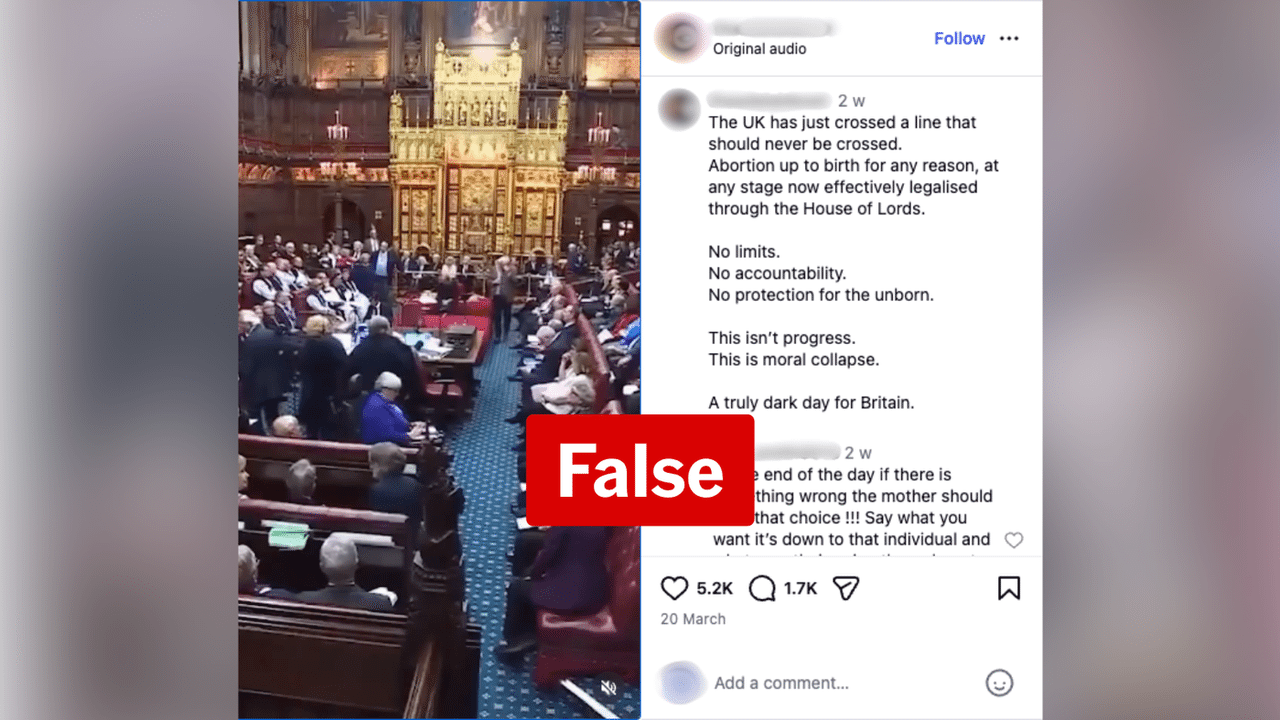
It includes footage from the UK's parliament from March 18, where the upper house voted on amendments to the Crime and Policing Bill - a broad government bill making changes to various criminal laws.
AAP FactCheck contacted the user for evidence to support the claim, but received no response.
Members of the House of Lords voted to keep Clause 246 in the bill (page 307) that would remove sections of the Offences Against the Person Act 1861 and the Infant Life (Preservation) Act 1929, which both impose a sentence of up to life imprisonment for terminating a pregnancy.
The Abortion Act 1967 created specific exemptions to these laws and allows for abortion up to 24 weeks' gestation if authorised by two doctors and where continuing the pregnancy poses a greater risk to the woman’s physical or mental health, or her existing children's.
A termination can be performed beyond 24 weeks if it is necessary to save life or prevent severe injury, or if there is a substantial risk the child would suffer from serious physical or mental abnormalities, the act states.
The procedure must take place in a National Health Service hospital or at home if it is before 10 weeks' gestation.
Emily Ottley, a fellow in medical law at the London School of Economics, told AAP FactCheck the claim was inaccurate.
As the older laws remain in force, the clause was introduced in response to increasing investigations, prosecutions and convictions of women in England for terminating their own pregnancies outside the legal parameters, she said.
"The amendment will not make any substantive changes to the Abortion Act 1967, which establishes the conditions for lawful abortion," Dr Ottley said.
Claire Pierson, an expert in reproductive politics at the University of Liverpool, told AAP FactCheck that the clause would prevent pregnant women from being prosecuted for accessing abortion outside the parameters of the 1967 Act.
However, healthcare providers and anyone supporting someone in procuring an abortion outside those parameters can still be prosecuted, Dr Pierson said.
Sally Sheldon, a professor of health care law at the University of Bristol, said the change will bring English and Welsh law in line with most other European countries and Australian states.
"This will affect the legal liability of only a very small group of - judging by the cases that have been prosecuted in recent years - what we know to be highly vulnerable women."
The Crime and Policing Bill has not yet been confirmed as law and will return to parliament on April 16.
Reuters has also debunked the claim.
AAP FactCheck is an accredited member of the International Fact-Checking Network. To keep up with our latest fact checks, follow us on Facebook, Instagram, Threads, X, BlueSky, TikTok and YouTube.


