
What was claimed
A pedophile anti-discrimination bill will define pedophiles as part of the LGBTQI community.
Our verdict
False. The law updated a definition of sexual orientation and does not define pedophiles as part of the LGBTQI community or protect them from discrimination.
AAP FACTCHECK - A US state has not passed a "Pedophile Anti-Discrimination Bill" that defines pedophiles as part of the LGBTQI community, despite claims online.
The claim misrepresents a 2023 law in the US state of Connecticut that updated the definition of sexual orientation in the state's anti-discrimination laws.
The legislation does not mention pedophiles or provide them with any new legal protections.
The claim appears in a June 10 Facebook video that discusses the Connecticut bill and warns "Aussies we be next" (sic).
The background of the video includes a heading that refers to the "HB6638 Pedophile Anti-Discrimination Bill" and an infographic that claims "'minor ATTRACTED people' or 'MAPs' are included by definition in HB6638 and are part of the 'Q+' of LGBTQIA+".
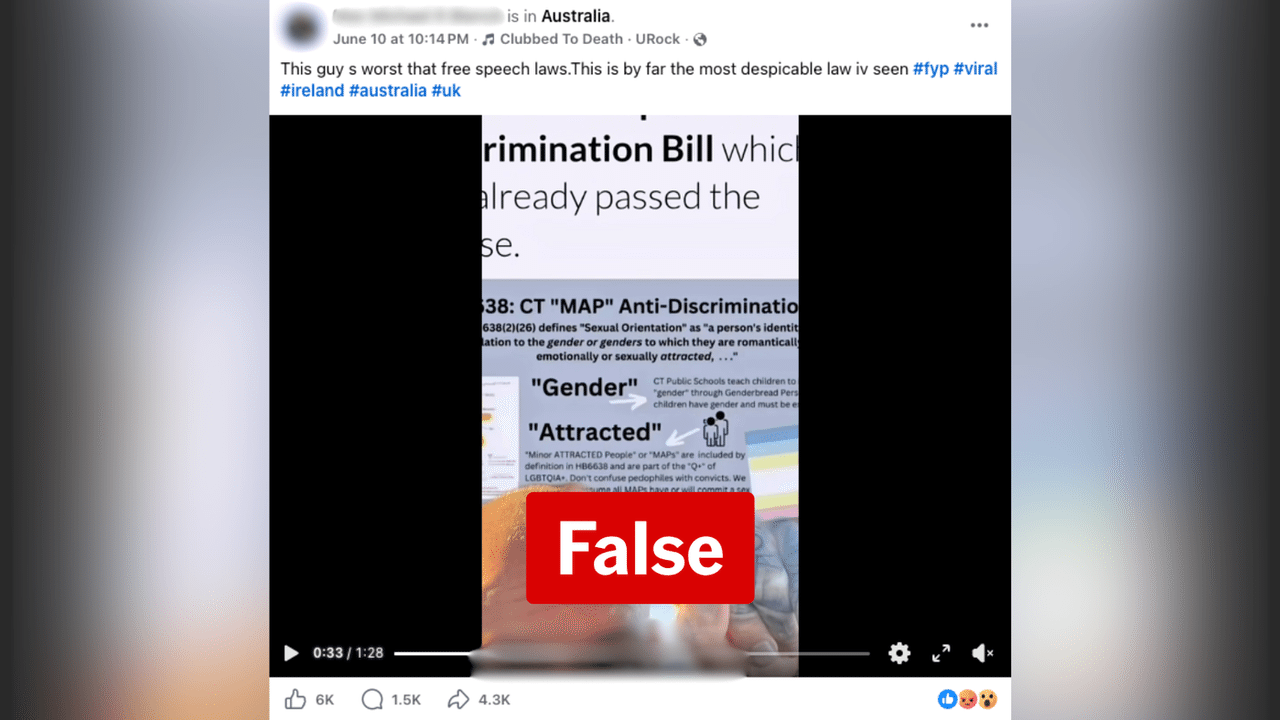
"Now they're trying to pass a pedophile law," a man in the video says.
"So this HB6638 Pedophile Anti-Discrimination Bill, which has already been passed in the house apparently…
"So it basically means you're attracted to a minor. Alright? ... And they want to be coming into this LGB community, and they want us, all around them, to accept (inaudible) pedophile, and we're supposed to be OK with that because it's a sexual preference."
The false claim originally spread online after House Bill 6638 was passed by the Connecticut parliament in 2023.
The legislation was not called the Pedophile Anti-Discrimination Bill and does not include any mention of pedophiles, pedophilia or "minor attracted people".
Instead, the law amended the definition of "sexual orientation" in the state's anti-discrimination laws, removing references to sexuality being a "preference".

The state's law previously defined sexual orientation as "having a preference for heterosexuality, homosexuality or bisexuality, having a history of such a preference or being identified with such a preference", while specifically excluding behaviour that constitutes a sex offence under the state's criminal code, including sexual offences related to a minor.
The new definition reads: "'Sexual orientation' means a person’s identity in relation to the gender or genders to which they are romantically, emotionally or sexually attracted, inclusive of any identity that a person (A) may have previously expressed, or (B) is perceived by another person to hold."
A 2023 report by Connecticut's state assembly judiciary committee explaining the reasons for the bill said the previous definition used the outdated terminology of "preference" regarding sexual orientation, which could be "to many, offensive".
The previous definition's reference to the criminal code also "plays into longstanding stereotypes connecting homosexuality, bisexuality, and criminal deviancy", it noted.
The law also added age as a protected class under the state's anti-discrimination laws, alongside the existing classes such as religion, national origin and sex.
But there is nothing in the legislation that redefined pedophilia to "minor attracted persons" or included it under the definition of sexual orientation.

Claims about the bill have been debunked by multiple fact-checking publications.
Brian Soucek, a law professor at the University of California, told PolitiFact in 2023 that the bill did not protect pedophiles.
"There is (absolutely) no textual support for the notion that age-based attraction would be a protected class under the bill, and it is unimaginable that a court in the United States would ever read this language to protect pedophiles or anyone else engaged in criminal activity."
Anya Bernstein, a law professor at the University of Connecticut, told AP Fact Check in 2023 that the bill "will have no effect on pedophilia whatsoever".
She said the new definition only protected people's identity regarding the gender of the people they are attracted to and said nothing about the age of those people.
Child sexual abuse is prohibited under Connecticut's state criminal code.
AFP Fact Check also debunked the claim in 2023.
AAP FactCheck is an accredited member of the International Fact-Checking Network. To keep up with our latest fact checks, follow us on Facebook, Instagram, Threads, X, BlueSky, TikTok and YouTube.


