What was claimed
A 2026 UN survey of conditions in Gaza proves an earlier UN-backed famine declaration was incorrect.
Our verdict
False. The 2026 survey was carried out nearly a year after the famine was declared and didn't contradict the earlier declaration.
AAP FACTCHECK - A 2026 UNICEF survey does not contradict a UN-backed declaration that famine occurred in Gaza in 2025, despite claims online.
The survey found acute child malnutrition rates had fallen in Gaza in June 2026, following a ceasefire between Israel and Hamas, and expanded humanitarian aid.
However, UNICEF says the 2026 survey does not disprove the 2025 famine declaration.
The claim appears in an August 25 Facebook video that says a new UN report found the 2025 famine declaration was wrong.
"In 2025, the UN claimed that there was irrefutable evidence of famine in Gaza," a person in the video says.
"And in 2026, a new report from that same UN body proves that all of those claims were bogus."
However, the report referenced in the video did not cast doubt on the 2025 famine declaration. Instead, it found acute malnourishment had declined since the declaration of famine.
The Integrated Food Security Phase Classification (IPC), a UN-backed global hunger monitor, declared a famine in parts of Gaza on August 22, 2025.
That day, UN relief chief Tom Fletcher declared there was "irrefutable testimony" that a famine was taking place.
The Facebook clip includes an image of a July 2026 IPC report snapshot assessing acute food insecurity in the Gaza Strip between April and June 2026.
The snapshot said conditions in Gaza had improved due to increased humanitarian aid following the October 2025 ceasefire, but acute food insecurity remained widespread (page 1).
It did not reference the IPC's August 2025 famine determination.
Instead, it included a graph showing that the number of acutely malnourished children enrolled in treatment programs peaked in August 2025, when the famine was declared, before steadily declining (Graph 4, p3)
The Facebook video suggests a survey referenced in the IPC report found "acute malnutrition across Gaza ranged from 0.2 per cent to 0.8 per cent" (timestamp 20 seconds).
Those figures are included in the full 2026 IPC report on conditions in Gaza (p43), which attributes them to UNICEF’s 2026 Gaza SMART Survey, conducted by the State of Palestine Nutrition Cluster, which UNICEF leads.
SMART stands for Standardized Monitoring and Assessment of Relief and Transitions, a widely used methodology for assessing malnutrition in children.
The SMART survey assessed the nutritional status of children aged 0–59 months and women aged 15–49 years living within accessible areas of the Gaza Strip between May 31 and June 15, 2026.
It states that the rate of acute malnutrition, based on a weight-for-height measure, ranged from 0.2 per cent to 0.8 per cent across different regions of Gaza (p21).
However, the SMART survey does not contradict the IPC famine declaration in 2025.
A summary of the report stated the findings "do not provide information about nutritional conditions before or after the survey period, nor do they serve as a nationally representative statistic for international comparison".
Toby Fricker, the UNICEF State of Palestine chief of communication, said the survey cannot show what conditions were like in August 2025, when famine was declared, and was not designed for that purpose.
"Both findings stand: Famine was confirmed then, and acute malnutrition among children has fallen since," he told AAP FactCheck.
"That improvement is a product of the assistance delivered in between, not evidence that it was unnecessary."
Francesco Checchi, an expert on international health at the London School of Hygiene and Tropical Medicine, agreed the 2026 survey referred only to recent conditions in Gaza, not those experienced in August 2025.
"Quite simply, conditions in Gaza (at least on the nutritional front) began improving from August-September 2025 onwards, such that IPC reports from that time to the present date have concluded that famine conditions are no longer occurring," Professor Checchi told AAP FactCheck.
UNICEF's 2026 survey concluded that Gaza's nutritional situation remained fragile, warning that reduced humanitarian access could alter progress (page 50).
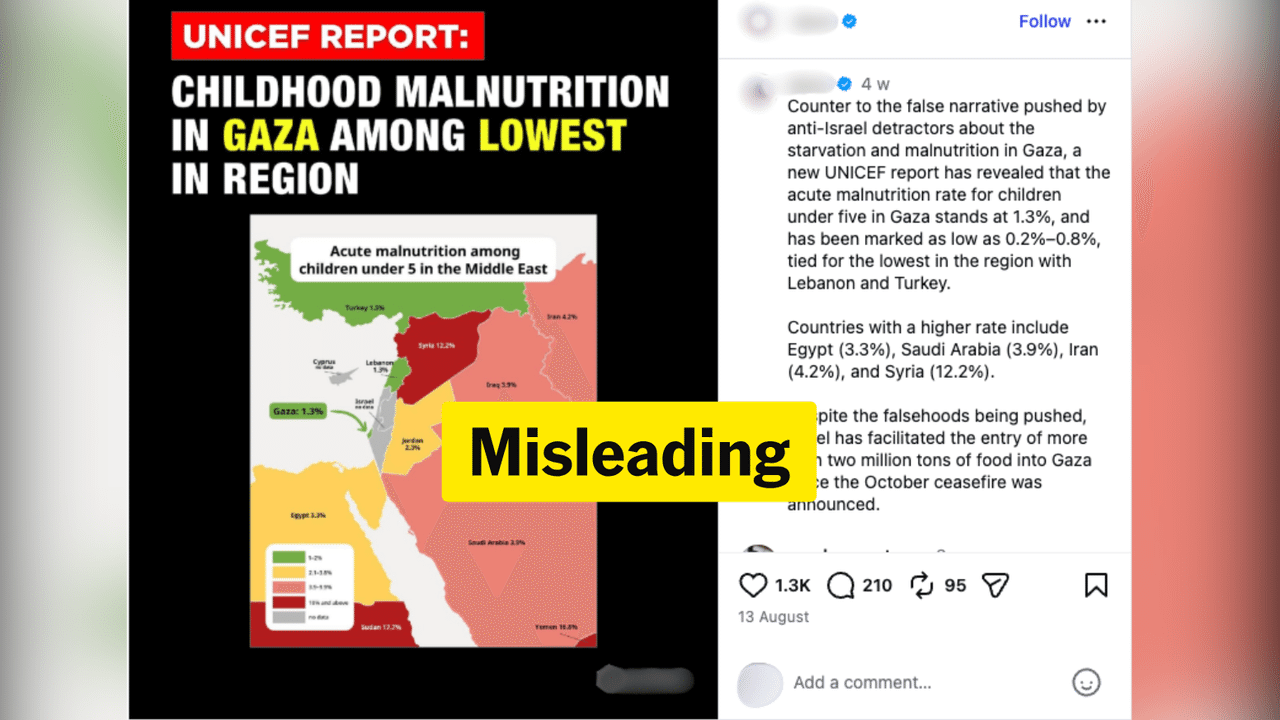
The Facebook video also features a map of the Middle East that purports to show acute malnutrition rates for children under five across the region (timestamp 0:29).
The map has appeared in dozens of other posts on social media about the report.
The video claims this is evidence that acute malnutrition rates in Gaza are significantly lower than neighbouring countries.
"[The acute malnutrition rate in Gaza] is not only comparable or lower to the 0.8 per cent before the war, it's significantly lower than neighbouring Arab countries like Egypt, Jordan, and Syria," the person in the video says.
Prior to the Israel-Hamas war, a 2021 survey found Global Acute Malnutrition among children under five in Gaza was 0.8 per cent, according to a 2023 IPC report (p7).
However, the cross-country comparison shown in the map is misleading because it is based on different methodologies, data sets, periods and operational contexts.

It lists Gaza’s acute malnutrition rate as 1.3 per cent, matching the Gaza Strip’s combined acute malnutrition rate calculated using an alternative measure, MUAC (mid-upper arm circumference), in UNICEF’s 2026 survey (pp. 22–23).
Data for neighbouring countries match child wasting rates from the 2025 Global Hunger Index (GHI), which does not include figures for Gaza.
The GHI is a peer-reviewed annual report that measures hunger levels worldwide. The 2025 GHI report was based on data available from 2020 to 2024.
Mr Fricker said comparing the 2026 SMART survey to the 2020-24 GHI data for other countries was not appropriate.
"A SMART survey is not designed to provide internationally comparable datasets," he said.
"It measures nutritional status in a defined population, representative within its sampling scope, over a short window, in order to guide the humanitarian response. It is not built to support cross-country ranking."
The 2026 UNICEF survey was also only conducted in accessible areas of Gaza, which tended to have greater access to humanitarian support, Mr Fricker said.
"As the excluded areas are those with the least humanitarian access…malnutrition prevalence there would be expected to be higher than the survey records," he said.
The 2025 GHI report stated that data gaps prevented it from calculating a complete GHI score for the occupied Palestinian territories (page 5).
AAP FactCheck is an accredited member of the International Fact-Checking Network. To keep up with our latest fact checks, follow us on Facebook, Instagram, Threads, X, BlueSky, TikTok and YouTube.


