
What was claimed
Nearly 60,000 Indian migrants arrive in New Zealand each year.
Our verdict
False. The figure is based on visas issued, not arrivals, and around 17,000 Indian migrants arrived in the past year.
AAP FACTCHECK - A New Zealand First candidate is claiming nearly 60,000 Indian migrants are arriving in the country each year, but the true figure is much lower.
The 60,000 figure refers to migrant visas granted, not migrant arrivals.
Around 17,000 Indian migrants arrived in New Zealand between August 2025 and July 2026, and the long-term average since 2002 is around 12,500 per year.
New Zealand First’s Rotorua candidate Billy Brown made the claim in an October 5 Facebook post.
"WE HAVE A MASS MIGRATION ISSUE," the post reads. "We’ve got nearly 60,000 Indians coming in every year."
It includes a graphic that states: "Mass Migration. Enough is Enough. Nearly 60,000 Indian Migrant arrivals in one year."
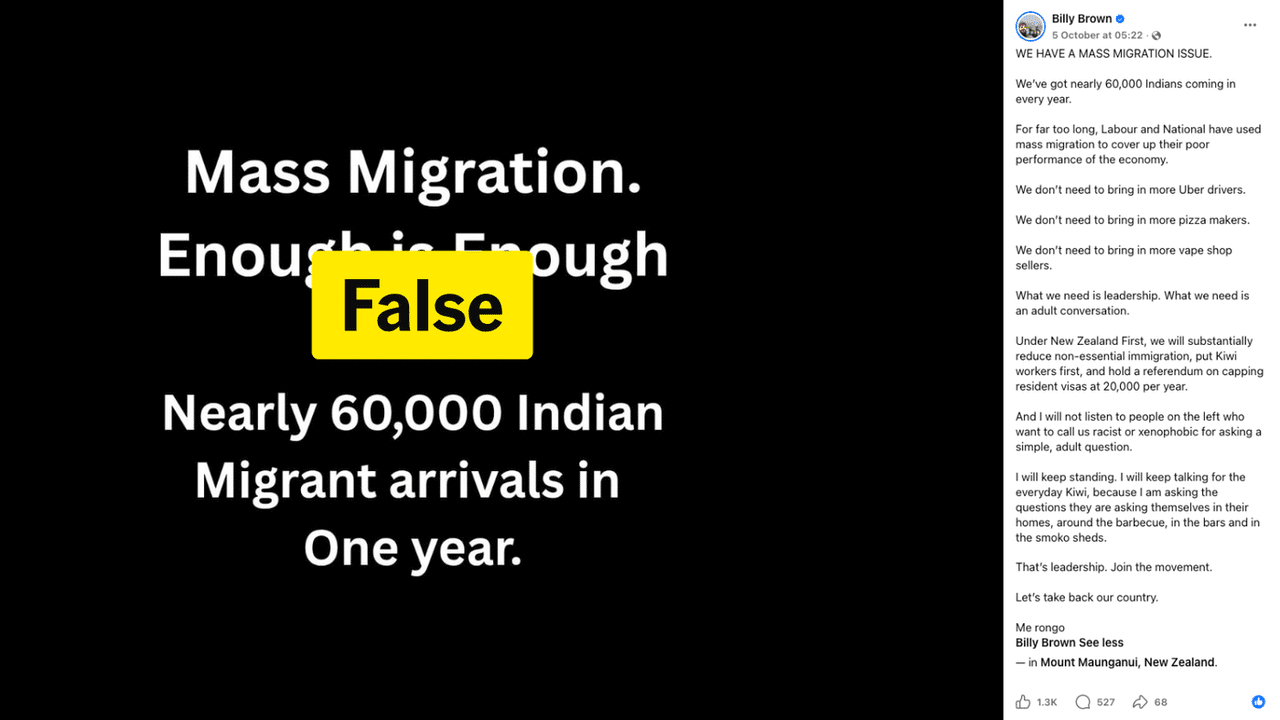
When asked for the evidence for this claim, Mr Brown said it was based on data collated by the independent Figure.NZ website for work visas, student visas and residence visas granted to Indian nationals.
These figures show a combined total of 53,109 Indian citizens were granted visas across those three categories in 2025, according to AAP FactCheck calculations.
The Figure.NZ data is sourced from the government's migration data explorer and broadly matches the official figures.
These figures do not show migrant arrivals in a given year, however, and experts told AAP FactCheck that migrants often obtain several different visas throughout a year, meaning they may be double- or triple-counted.
Francis Collins, an expert on international migration at the University of Auckland, said official migration figures from Stats NZ showed Indian migration was significantly lower than Mr Brown claimed.
"People gaining residence visas may well have been issued a work and/or study visa in the same year, i.e. they could be double or triple counted," he said.
Likewise, many people are granted multiple work and study visas in a given year, especially if they change jobs or study arrangements, Prof Collins said.
Additionally, many of the Indians in the visa figures cited by Mr Brown would have already been in New Zealand when the visa was granted, he said.
Stats NZ figures for the year to July 2026, the latest available at the time of publication, show 16,800 Indian citizens migrated to New Zealand in that 12-month period.
Another 5,300 Indian citizens left the country, resulting in a net increase of 11,500 for the year from August 2025 to July 2025.
Prof Collins said the net figure provided the most accurate picture of migration from India.
The Stats NZ July 2026 figures are provisional. Final migration figures are released after 17 months because a migrant is defined as a person spending at least 12 of the past 16 months in New Zealand, called the 12/16 month rule.
Annual figures back to 2002 are available on StatsNZ's Infoshare website (Tourism; International Travel and Migration; Estimated migration by direction and country of citizenship, 12/16-month rule (Annual-Jul)).

That data shows annual Indian migrant arrivals averaged 12,530 between 2002 and 2026, measured from August to July.
Indian migrant arrivals peaked in the year to July 2024 - after the relaxation of COVID-19 border restrictions - with 37,611 arrivals and 3965 departures for a net gain of 33,646 Indian migrants.
Paul Spoonley, a migration expert at Massey University, also referred to the Stats NZ migration figures, which he said were "the most authoritative", and agreed the visa figures would include double-counting.
"The residence visas include those approved under the skilled category who will also appear under the work visas graph," Professor Spoonley told AAP FactCheck.
"The number of arrivals provided every few months by Stats NZ are a better indication of the number of Indians migrating to NZ."
AAP FactCheck is an accredited member of the International Fact-Checking Network. To keep up with our latest fact checks, follow us on Facebook, Instagram, Threads, X, BlueSky, TikTok and YouTube.


