
Russia has pounded the Ukrainian capital Kyiv and the surrounding region with scores of missiles and drones in a night-time aerial attack that lasted for hours and killed at least 14 people.
Moscow's forces have in recent months intensified their ballistic missile attacks on Kyiv, exploiting Ukraine's chronic shortage of US-made Patriot air defence interceptors, the sole weapon in its arsenal able to shoot down ballistic missiles.
Ukrainian President Volodymyr Zelenskiy has pleaded for countries to send more Patriot interceptors but international stockpiles are low amid the Iran war and Ukraine's more than four-year fight against Russia's all-out invasion.
Russia's overnight barrage also included cruise missiles and fast-flying jet-powered drones that put further strain on air defences, the Ukrainian air force said on Thursday.
Explosions boomed across the city throughout the night. Kyiv was the primary target, but hits were recorded at 28 locations across the country, according to the air force.
About 40 people were wounded, Zelenskiy said, as air raid warnings remained in place until after dawn.
“It was a massive attack,” Zelenskiy said on social media, adding that Russia “had been preparing (it) for a long time, combining different types of ballistic missiles, cruise missiles and drones, aiming to cause as much damage as possible to civilian infrastructure".
But the Russian defence ministry said the attack struck a Kyiv industrial site manufacturing components for Ukraine’s Flamingo cruise missiles.
Sites involved in the production and storage of drones, an ammunition depot and a logistics centre were also hit, it said.
Russia and Ukraine have battered each other with drones and missiles as their armies struggle to gain the upper hand on the 1250km front line, where huge numbers of drones are pinning down troops.
Ukraine has attempted to shift the war onto Russian soil through long-range drone strikes on oil facilities and other infrastructure.
The Russian defence ministry said air defences shot down 726 Ukrainian drones overnight over a number of Russian regions, annexed Crimea and the Black and Azov seas, in one of Ukraine's biggest aerial attacks of the war. There were no immediate reports of damage or casualties.
Russia’s relentless onslaught on Kyiv has spooked other European countries, especially those bordering Ukraine, which fear what Russian President Vladimir Putin might have in store for the continent.
As the Russian attack on Kyiv unfolded, the Polish Armed Forces Operational Command activated its military aviation operations, ground-based air defence systems and its radar reconnaissance.
Polish and other NATO military aircraft were deployed to monitor the country’s airspace, Polish news agency PAP reported.
Romania’s defence ministry said that an unidentified drone crashed and caught fire in an uninhabited area near the border with Ukraine.

Two Spanish F-18 jets, deployed on an air policing mission in Romania, were scrambled to monitor a group of “air targets” near the border, the ministry said.
Also, Moldova’s defence ministry said its airspace was breached by an unauthorised drone.
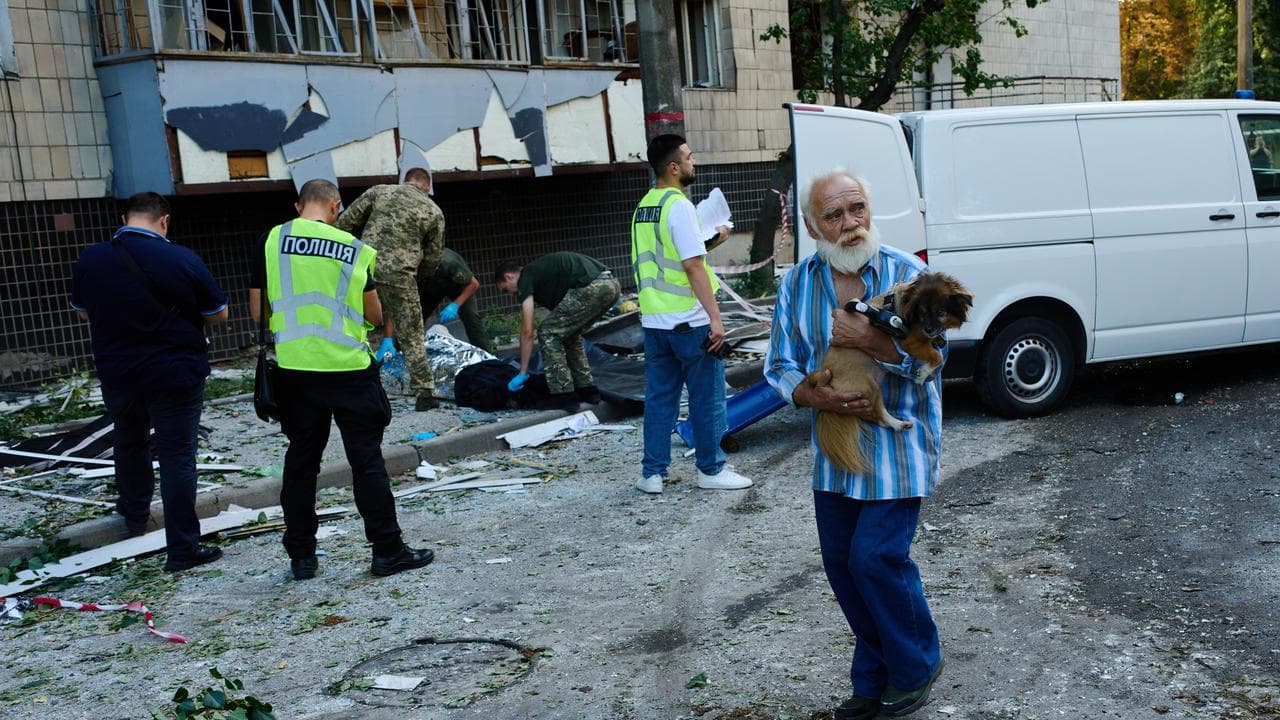
Russia's overnight strikes hit 12 locations across Kyiv’s Darnytskyi, Sviatoshynskyi and Solomianskyi districts, damaging residential buildings, a medical facility and an educational institution.
Emergency crews were at the scene and pulled people out from under the rubble.
In Solomianskyi district, the top two floors of a nine-storey residential building were destroyed and fires broke out on other floors.
People were also trapped in two residential buildings and a school shelter.


