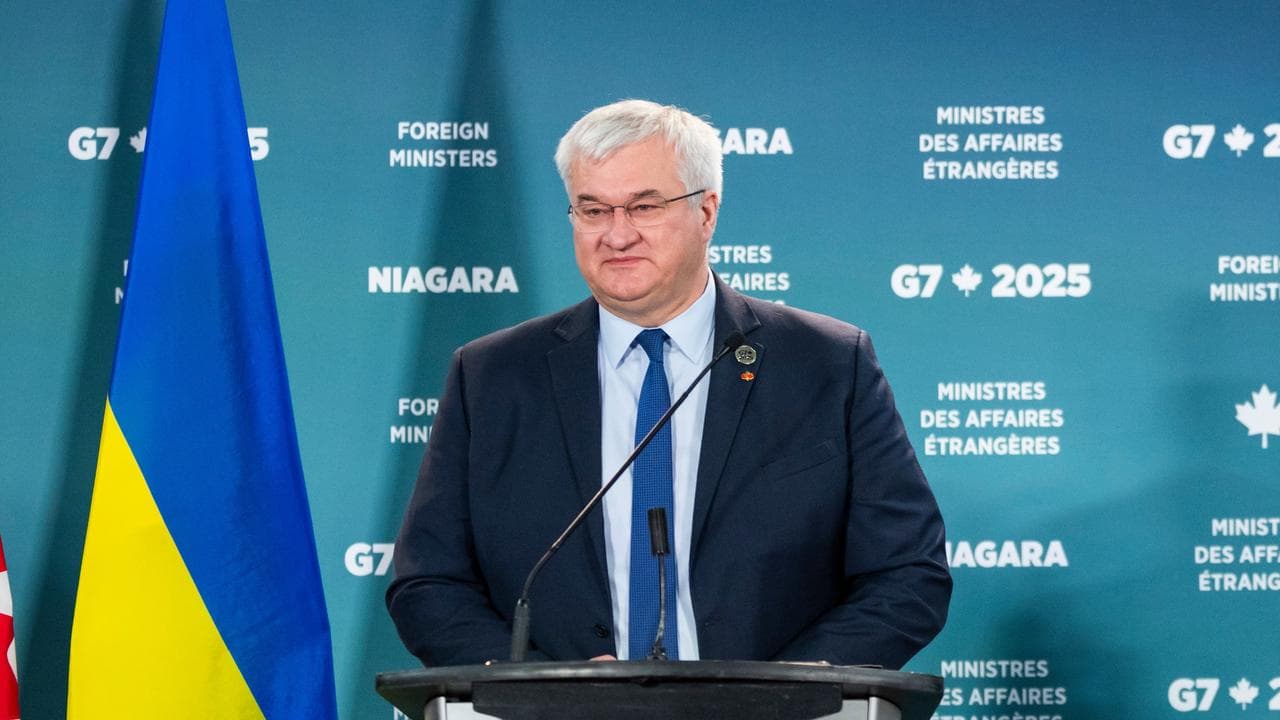
Ukraine's foreign minister says Ukrainian and Russian leaders need to meet in person to hash out the hardest remaining issues in peace talks, and that only US President Donald Trump has the power to bring about an agreement.
Ukraine wants to accelerate the efforts to end the four-year-old war and capitalise on momentum in the US-brokered talks before other factors come into play, such as campaigning for the US congressional mid-term elections in November, Foreign Minister Andrii Sybiha said in an interview.
"Only Trump can stop the war," Sybiha told Reuters in his office in Kyiv, close to the Dnipro river.
From a 20-point peace plan that has formed the basis of recent trilateral negotiations, only "a few" items remain outstanding, Sybiha said.
"The most sensitive and most difficult, to be dealt with at the leaders' level."
On key issues, such as land, the two sides appear far apart.
Russia has maintained its demand that Ukraine cede the remaining 20 per cent of the eastern region of Donetsk that it has failed to occupy during years of grinding, attritional warfare - something that Ukraine has steadfastly refused.
Ukraine also wants control over the Zaporizhzhia nuclear power plant - the largest in Europe - which is in Russian-occupied territory.
During a second round of trilateral peace talks in Abu Dhabi this week there was no sign of a breakthrough although an exchange of 314 prisoners of war was concluded on Thursday - the first such swap since October.
Ukrainian President Volodymyr Zelenskiy told reporters on Saturday that the US had proposed a new round of talks in Miami in a week, which Ukraine had agreed to.
"My assessment is we have momentum, that's true," Sybiha, in post since 2024, said in an interview conducted on Friday.
"We need consolidation or mobilisation of these peace efforts, and we're ready to speed up."
Sources had told Reuters on Friday that Ukrainian and US officials had discussed a timetable including a draft deal with Russia by March and a referendum on it in Ukraine alongside elections in May.
Ukraine is focused on obtaining security guarantees from its allies to deter future Russian aggression once a ceasefire enters force.
The US, Sybiha said, had confirmed to Ukraine that it was prepared to ratify security guarantees in congress; it would then provide a security "backstop" to support the peace deal although there will be no US troops on the ground in Ukraine.
"I personally do not believe, at this stage, in any security infrastructure or architecture without the Americans ... We must have them with us - and they are in the process. That's a huge, huge achievement," he said.
A statement issued after a meeting in Paris last month of the "coalition of the willing" said the allies would participate in a proposed US-led ceasefire monitoring and verification mechanism.
Officials have said this would likely involve drones, sensors and satellites, not US troops.
The foreign minister said some other countries beyond the United Kingdom and France, both already publicly committed, had confirmed their readiness to send troops to Ukraine as a deterrence force but he declined to identify them.
Apart from "boots on the ground," Sybiha said there should be a mechanism akin to the NATO military alliance's Article Five that classifies an attack on one member state as an attack on all.
Ukraine's proposed membership of the European Union would also provide an additional element of security, he said.
Zelenskiy has said Ukraine wants to join the 27-member bloc by 2027 - which would require significant reforms and legislation.
On Saturday, Zelenskiy raised concerns about bilateral talks between Russia and the US, which he said included a proposal from Russia for $US12 trillion ($A17 trillion) in investments.
Sybiha said some of these discussions could affect Ukraine’s sovereignty or security and that his government would not support any such deals made without Ukraine.


