Australia's share market has handed back an early gain to slip lower, with miners plunging after carrying the bourse for most of the week.
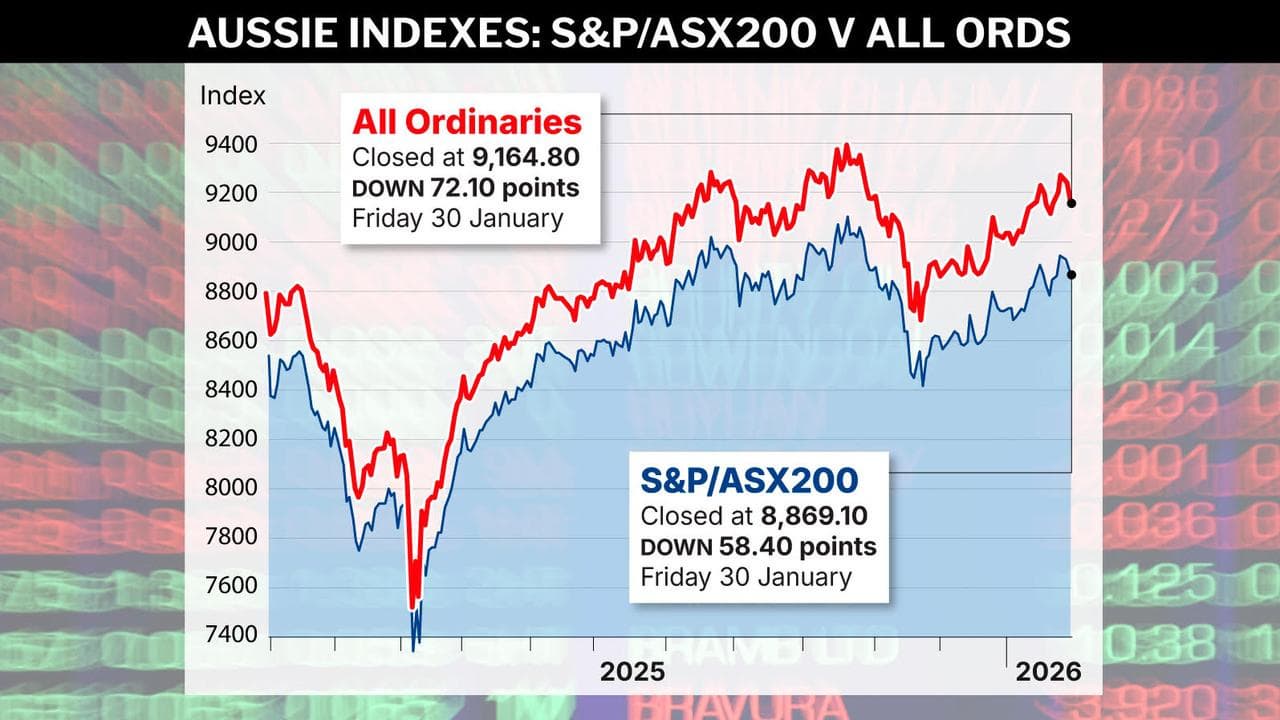
The S&P/ASX200 fell 58.4 points on Friday, down 0.65 per cent, to 8,869.1, as the broader All Ordinaries lost 72.1 points, or 0.78 per cent, to 9,164.8.
An early boost turned to dust by the afternoon, as the basic materials sector plummeted more than three per cent, led by gold stocks and further pummelled by massive outflows as investors cashed in on what had been a 13 per cent rally in January.
The about-face came as rumour spread that US President Donald Trump's Federal Reserve chair replacement would be someone less inclined to cut interest rates for the world's largest economy.
"It looks like Trump will announce his Fed chair pick tomorrow and, strangely enough, it's expected to be (former Fed Governor) Kevin Warsh," Capital.com senior market analyst Kyle Rodda told AAP.
"Someone who has a history of advocating for high interest rates and sizing inflationary risk over the labour market side of the Fed's mandate, so we saw gold and other commodity prices take a pretty big leg lower."
Friday's turnaround left the top-200 up only nine points since Monday, or 0.1 per cent higher for the week.
Spot gold fell almost nine per cent from Thursday's fresh record high of $US5,595 ($A7,990) an ounce, before settling near $US5,234, weighing on ASX-listed miners, which made up six of the top-200's worst performers.
Large-cap miners weren't spared from the sell-off, with BHP, Fortescue and Rio Tinto each down more than 1.8 per cent as China's iron ore stockpiles continued to grow and steel mill demand remained weak.
The "shiny new" sub-sectors of battery minerals and rare earths also sank despite a handful of positive December quarter production results during the week.
The heavyweight financials sector acted as a ballast against the mining sell-off, gaining 0.5 per cent and tracking similar gains for the big four banks.
Energy stocks had their flattest session of the week, eking a less than 0.1 per cent gain after oil prices helped lift the segment more than four per cent since Monday, against a backdrop of rising US tensions with Iran and sustained Russian attacks on Ukrainian energy infrastructure.
IT stocks tanked to 10-month lows, tracking a slip on Wall Street's Nasdaq, after concerns about artificial intelligence spending resurfaced despite strong US tech earnings.
Health care stocks topped the other sectors, up 1.1 per cent and tracking with a similar gain in blood plasma giant CSL, while Resmed shot 3.1 per cent higher after lifting revenue almost 10 per cent in the second quarter.
In company news, Nine Entertainment shares rose more than five per cent after it flagged a deal to offload its ailing radio assets and a separate plan to scoop up outdoor advertising group QMS.
Droneshield's share price has tumbled by more than a quarter over the week, and has fallen to roughly the same price point that preceded a major dump in November when its leadership suddenly offloaded $70 million in stock.
The Australian dollar is buying 70.01 US cents, down from 70.87 US cents on Thursday at 5pm as the greenback rebounded from recent weakness on expectations of a less-dovish-than-expected incoming Federal Reserve chair.
Turning to local monetary policy, the Reserve Bank will begin its two-day meeting on Monday and is widely expected to hike the local cash rate by 0.25 per cent to stem stubborn price growth at home.
ON THE ASX:
* The S&P/ASX200 lost 58.4 points, or 0.65 per cent, to 8,869.1
* The broader All Ordinaries fell 72.1 points, or 0.78 per cent, to 9,164.8
CURRENCY SNAPSHOT:
One Australian dollar trades for:
* US cents, from 70.01 US cents at 5pm AEDT on Thursday
* 107.77 Japanese yen, from 108.44 Japanese yen
* 58.71 euro cents, from 59.15 euro cents
* 50.89 British pence, from 51.22 British pence
* 115.71 NZ cents, from 116.42 NZ cents


