
What was claimed
Tobacco cures polyendocrine metabolic ovarian syndrome (PMOS).
Our verdict
False. There is no scientific evidence that nicotine can treat or cure PMOS.
AAP FACTCHECK - Claims are spreading online that nicotine can cure a common ovarian health issue, but experts say there's no evidence the drug is an effective treatment.
Polyendocrine metabolic ovarian syndrome (PMOS), formerly known as polycystic ovary syndrome (PCOS), is a hormonal condition that affects the ovaries.
Symptoms include irregular periods, excess facial or body hair, acne and infertility, according to the Australian government's Health Direct website.
There is no cure, but treatments and lifestyle changes can help, according to Health Direct.
However, an Australian Facebook user claims without evidence that nicotine can treat the condition.
In a video published on October 20, the man claims to have helped many women address issues with their periods with nicotine drops.
“I’ve been on the phone with over 2000 people this year helping put organic nicotine into their health routine,” he says in the video.
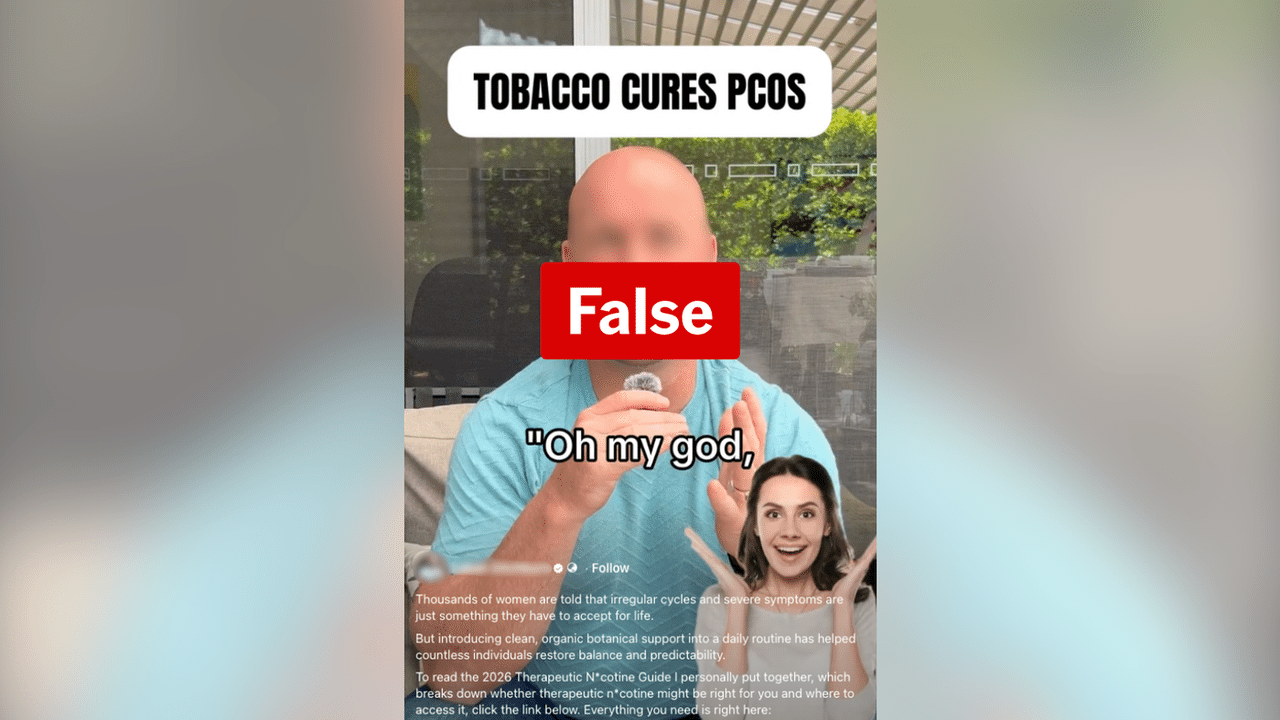
"I'm not going to tell you these drops are a cure, but what I will say is that the one thing that all of these women had in common, every single one of them was taking a few drops of organic tobacco every day to get their period back, and it worked."
"TOBACCO CURES PCOS," a text overlay on the video reads.
AAP FactCheck contacted the user for evidence to support the claim but received no response.
xperts told AAP FactCheck there's no evidence nicotine cures or treats PMOS.
Melanie Gibson, an expert in women's health at Te Herenga Waka Victoria University of Wellington, said nicotine is not identified as a treatment in the latest global review of PCOS evidence, but smoking is listed as a risk factor.
"There is no evidence that nicotine (or tobacco) can treat or cure PCOS," Associate Professor Gibson told AAP FactCheck.
The 2023 international guidelines for the assessment and management of the condition, developed by more than 3000 health professionals, list a number of treatments for managing symptoms - none of which include nicotine.
Smoking, however, is named as a "modifiable risk factor" associated with negative fertility outcomes (page 141), and "smoking cessation" is recommended as a way to increase fertility (p142).
Prof Gibson also referred to a 2022 review of nutritional supplements and complementary therapies used to treat PCOS, which did not include nicotine as an evidence-based treatment.

Likewise, she referred to a 2023 review of lifestyle strategies to manage PMOS, including herbal supplements, which did not recommend nicotine.
Rebecca Campbell, an expert in PMOS and fertility at the University of Otago, also said the claim in the Facebook post was incorrect.
"There is no clinical evidence to support that tobacco or nicotine can treat or 'cure' PCOS," Professor Campbell told AAP FactCheck.
"Nicotine is highly addictive and I would never recommend this as a therapy."
Prof Campbell said nicotine could potentially make a person feel better, but using the drug could have long-term negative effects, including dependence.
"The long-term consequences are not worth the potential for short-term gain," Prof Campbell said.
Beverley Vollenhoven, a PMOS expert at Monash University, said she has never heard of nicotine being an effective treatment for the condition.
"I would think that the risks of smoking outweigh any benefits if they are present at all," Professor Vollenhoven told AAP FactCheck.
womeAAP FactCheck is an accredited member of the International Fact-Checking Network. To keep up with our latest fact checks, follow us on Facebook, Instagram, Threads, X, BlueSky, TikTok and YouTube.


