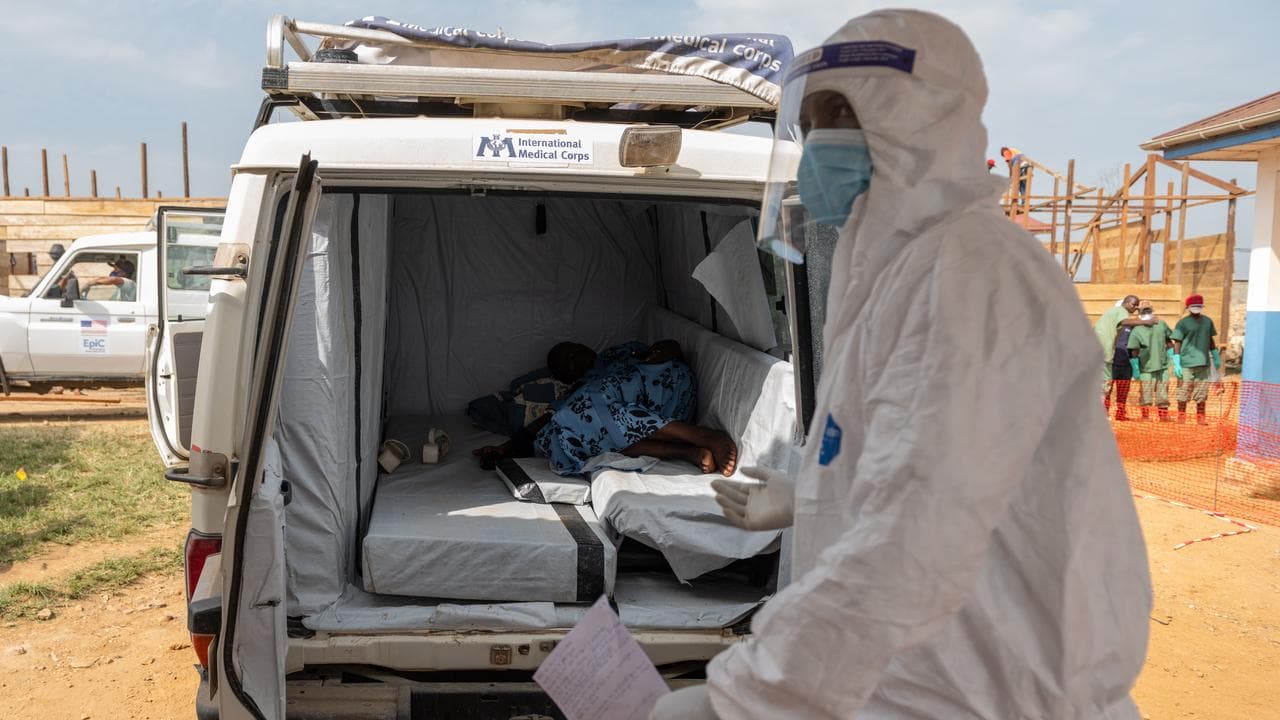
Armed assailants have removed a woman and her daughter from a health centre in eastern Democratic Republic of Congo, authorities say, raising fears of further spread of the Ebola virus.
The attackers, armed with bladed weapons, stormed a clinic near Butembo, North Kivu province, late on Monday and took the pair away, according to a provincial notice seen by Reuters.
The notice did not identify the assailants or give their motives.
It said the six-year-old child had tested positive for Ebola.
The incident underscores how insecurity and community distrust of health workers are undermining efforts to contain the outbreak in eastern DR Congo, where repeated attacks on medical staff and response teams have disrupted efforts to trace contacts and isolate suspected cases.
"Until now we have not yet found the two people we are searching for. We are making a solemn appeal for them to go as soon as possible to an Ebola treatment centre, as their return to the community risks worsening their health and, above all, infecting their relatives," Dr Lubambo Maboko Gaston, the Ebola response incident manager in North Kivu, told Reuters.
Lubambo said no medical staff were injured in the attack, adding that the health centre was not protected by the army or the police.
The incident comes amid a series of security incidents targeting Ebola responders in eastern DR Congo, including recent attacks on safe burial teams and treatment centres in neighbouring Ituri province.
North Kivu has so far recorded 67 confirmed cases and 38 deaths, according to government data published on Tuesday, making it the second most affected province after Ituri, which accounts for more than 90 per cent of cases.
Across the country, the outbreak has infected 837 people and killed 196, government data showed.
The head of Africa's Centres for Disease Control and Prevention warned on Tuesday that the DR Congo Ebola outbreak could be the worst ever.
The disease, transmitted through body fluids even after death, is spreading fast across three provinces in the DR Congo, government data shows.
"If we don't stop the outbreak very soon it will be worse than what we had in west Africa and eastern DRC," Africa CDC Director-General Jean Kaseya told a virtual meeting of African heads of state and donors in Burundi.
His warning, which echoed a similar projection by the US CDC, referred to the outbreak that affected Guinea, Liberia and Sierra Leone from 2014 to 2016, which killed more than 11,000 people, and a less deadly 2018 outbreak in DR Congo.


