
What was claimed
A native title claim over Melbourne means people could be forced to leave their homes.
Our verdict
False. Native title determinations do not apply to freehold private property.
AAP FACTCHECK - An Aboriginal land claim over Melbourne will not threaten private property rights, as has been claimed on social media.
A native title claim for Melbourne and its surrounds was lodged in October.
Among the falsehoods spreading online is that it will impact people's homes. However, native title cannot be claimed over freehold private land.
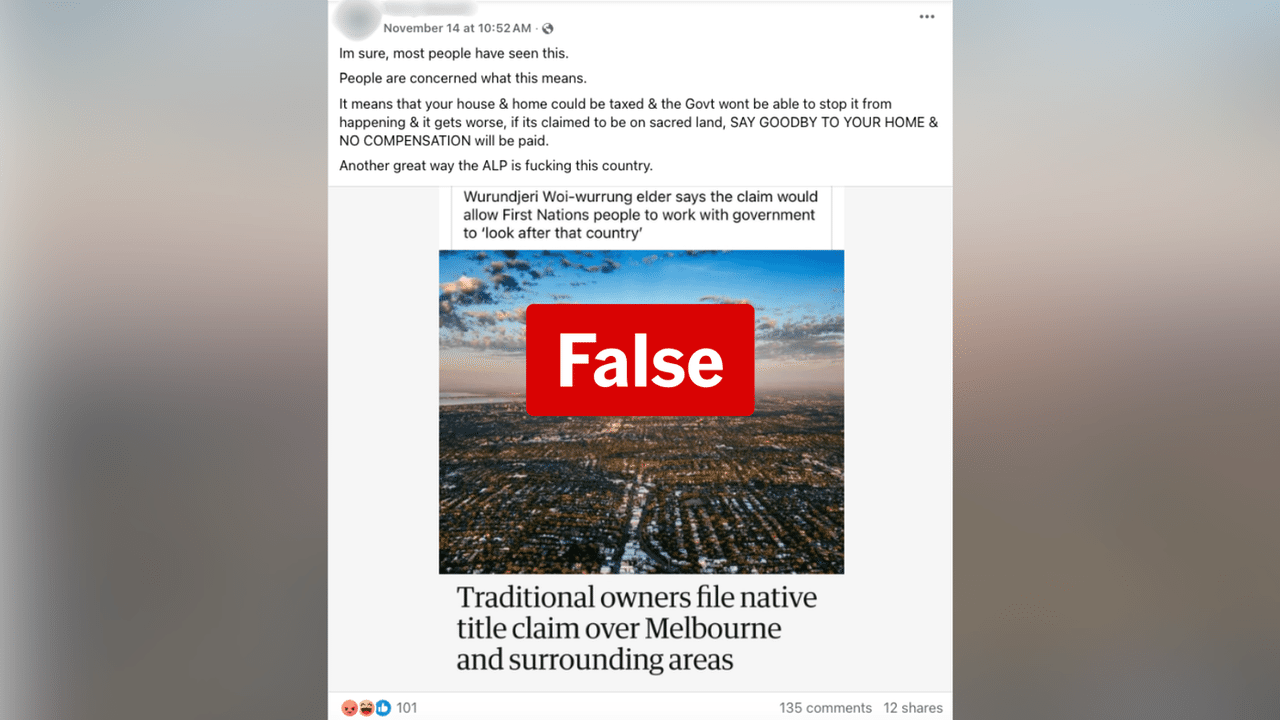
Responding to news of the application, a November 14 Facebook post suggests people could lose their homes without compensation.
"...if its claimed to be on sacred land, SAY GOODBY TO YOUR HOME & NO COMPENSATION will be paid [sic]," the post reads.
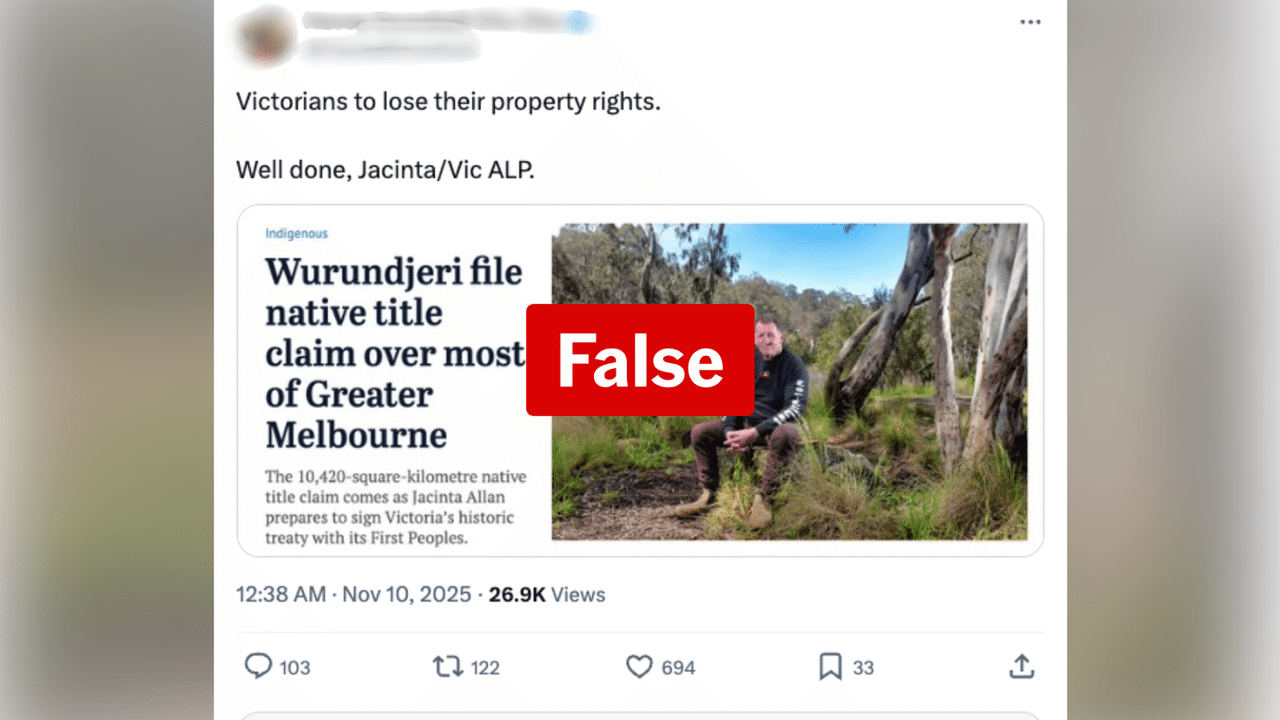
False claims are also being shared on X, including posts that say Victorians will lose their property rights or describe native title as a "land grab" for private property.
The Wurundjeri Woi-Wurrung people lodged the claim on the same day that Victoria became the first Australian state to legislate a formal treaty with Aboriginal people.
The claim covers more than 10,000 square kilometres, including all of central Melbourne, according to the application.
If successful, it would be the third native title determination that covers a capital city.
The Kaurna people were recognised as native title holders over Adelaide in 2018, and the 2021 Noongar native title settlement in Western Australia includes Perth.
If native title is granted, it could recognise certain Wurundjeri Woi-Wurrung’s rights to use Crown land in line with their laws and customs, along with the right to be consulted on what happens to that land.
This could be via an exclusive native title, which provides the applicant with the exclusive right to occupy Crown land, or more limited non-exclusive rights.
This could include the right to undertake activities such as living or camping on Crown land, lighting fires, hunting and fishing, but only where this doesn't conflict with the pre-existing rights of others, including leaseholders.
In any case, it would have no impact on private property rights.
Native title does not apply to privately-owned freehold land, according to the Native Title Act 1993.
Section 23A states native title is completely extinguished and therefore can't be recognised if previous Commonwealth acts granted exclusive possession of the land, including via freehold titles, exclusive leases and the establishment of public works.
Kate Galloway, a law professor at RMIT University, said there is no provision in the act for homeowners to be evicted from their properties.
"The very nature of native title, as established by the Mabo case and carried on under the Native Title Act, is that creation of private property (freehold titles) will automatically extinguish native title," Professor Galloway told AAP FactCheck.
"Once a person has private property, there is no longer any native title to be claimed.
"As a system of recognition of Indigenous rights to land, it has not, does not, and will not, cause disruption to any private property, including eviction."
The post also claims native title could result in people's houses being taxed.
Prof Galloway said there is no provision for new taxes to arise from any native title claim or determination.
"This statement is supported by no evidence," she said.
In instances where Traditional Owners' connection to land has been disrupted due to activities including land clearing, public infrastructure and granting of freehold titles for private property, native title is extinguished and can't be recognised.
However, the law allows for Indigenous groups to seek compensation for this loss, according to a Queensland government website.
Generally, a state or territory government or the Commonwealth government would be liable to pay any compensation, according to the National Native Title Tribunal (NNTT).
However, it states there may be circumstances where compensation is payable by other persons instead.
An NNTT spokesperson told AAP FactCheck this could arise if a state or territory legislated to make others liable for compensation in certain circumstances.
In Western Australia, for example, the state government has legislated that if native title compensation is granted related to a mining licence, then the licence holder or applicant is liable.
Compensation can be significant. Under a native title settlement over land including Perth, the Western Australian government agreed to make 12 annual payments of $60 million to the Noongar Boodja Trust.
Prof Galloway said native title determinations are made through the court process or in negotiation with the relevant state government.
"To establish the native title rights and interests and whether they are exclusive or non-exclusive, the claim group engages specialist anthropologists," Prof Galloway said.
Anthropologists research and write a report addressing the Indigenous groups' connection to country, she explained.
"The state examines anthropological reports carefully to work out whether it will accept the report or challenge it.
"This process takes years and years."
AAP FactCheck is an accredited member of the International Fact-Checking Network. To keep up with our latest fact checks, follow us on Facebook, Instagram, Threads, X, BlueSky, TikTok and YouTube.


