
All AFL and AFLW players will be hair-tested for drugs twice a year under a revamped policy trumpeted as the toughest in Australian sport.
The AFL and its players' association have an in-principle agreement for the fresh Illicit Drugs Policy (IDP) which ditches the oft-criticised current three strikes model.
AFL chief executive Andrew Dillon said it would be "the most stringent illicit drugs policy in Australian sport".
"We have had a policy in place for 20-plus years which has served the game well," Dillon told reporters in Melbourne.
"But we're in 2026 and we want a policy that reflects now."
The new policy features a suspension range of two to four matches for players caught using illicit drugs in public.
A club's doctor and club psychologist will be informed of an initial positive test.
And players who test positive to illicit drugs three or more times will be sent to a panel at a newly-formed Joint IDP (Illicit Drugs Policy) committee.
The player's club president, chief executive and football manager will be among those told of the positive tests.
A major change is introducing a fitness to play assessment - a player could still be deemed able to play after three positive tests.
The player would be listed as 'unavailable' if deemed unfit to play.
The AFL detailed a stepped process after a positive illicit drugs test.
Initially, players will undergo a behaviour change program possibly including health care interventions.
After a second positive test, players will have an individual management plan including clinical assessments and treatments.
If a player continued to use drugs they would be sent for a fitness to play assessment by an independent panel.
"As a result of a fitness to play assessment, a player is determined to be fit to play, fit to play or train on stipulated terms, or unfit to play or train for a specified period and supported with intensive treatment," the AFL said.
"A player will progress from the framework when they have fully and successfully participated in their management plan."
AFL Players' Association chief James Gallagher said the playing cohort backed the new policy.
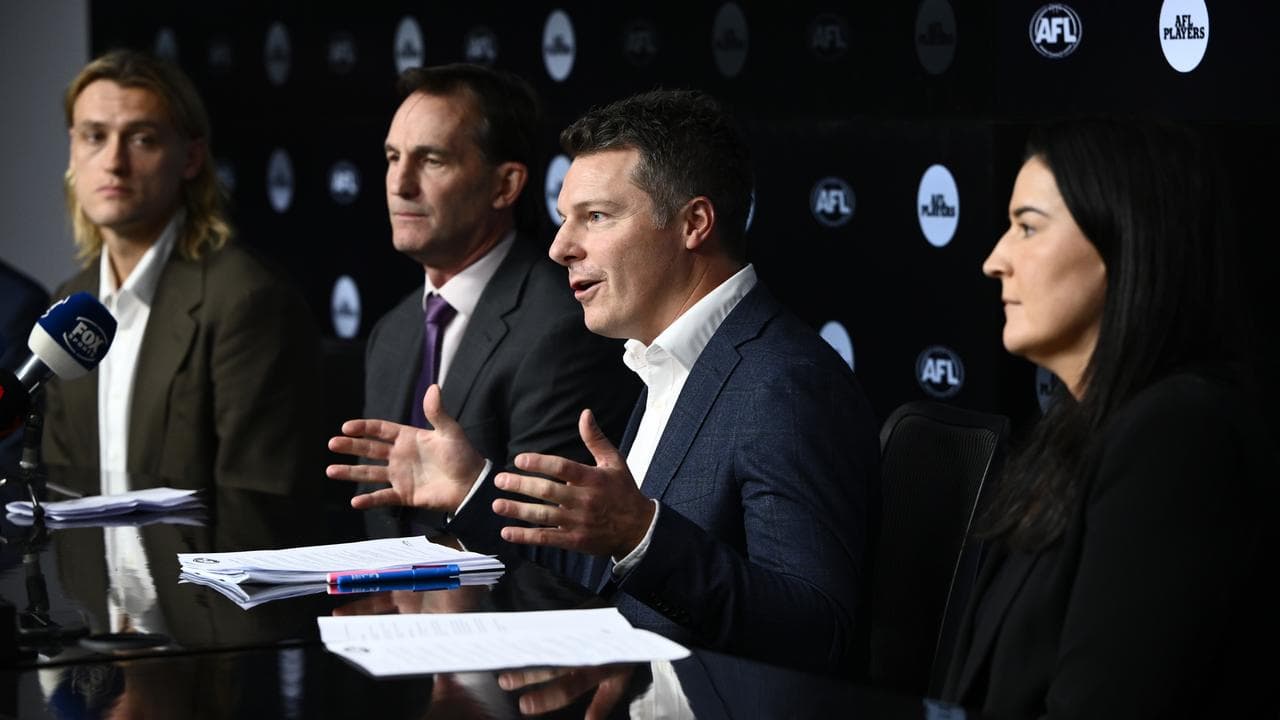
"The expert advice was really clear: the policy should be a harm reduction wellbeing policy, and the punitive measures were counter to that," Gallagher told reporters.
"But what we do want is accountability because it is about shifting behaviour."
There would be "more rigour" around the new policy.
"Less will be left to individualised club doctors to manage the athletes through this program," he said.
"There will be a lot more governance around it, there will be a committee that oversees this, there will be a new role appointed by the AFL ... that will have the conduct and running of it.
"All of that is geared towards making sure that there's a consistent approach that creates accountability."
The new illicit drugs policy sits alongside the World Anti-Doping Agency testing protocols for performance-enhancing drugs in AFL.


