The decision to ban transgender women from female events at the Olympic Games provides clarity and fairness to athletes, the Australian Olympic Committee says.
Olympic chiefs announced the new eligibility policy ahead of the Los Angeles Games in 2028, with competition restricted to biological women and an athlete’s status determined by a mandatory one-time gene-screening process.
It has been introduced under the leadership of IOC president Kirsty Coventry, who set up a review of “protecting the female category” last year when became the first woman to lead the Olympic body.
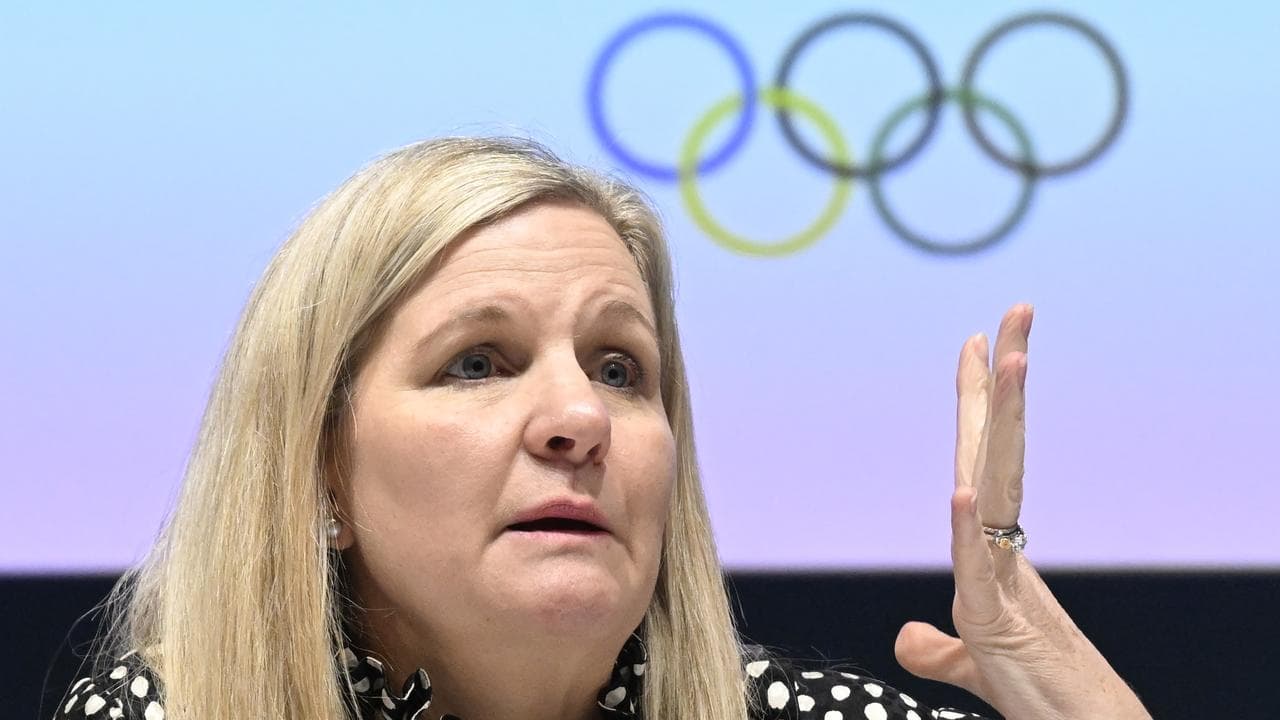
“At the Olympic Games, even the smallest margins can be the difference between victory and defeat,” Coventry, a two-time Olympic gold medallist in swimming, said in a statement.
“So, it is absolutely clear that it would not be fair for biological males to compete in the female category.”
The IOC and Coventry have wanted a clear policy instead of continuing to advise sports governing bodies who previously have drafted their own rules.
Before the 2024 Paris Olympics, three top-tier sports - track and field, swimming and cycling - had already passed rules excluding transgender women who had been through male puberty.
No woman who transitioned from being born male competed in Paris, though New Zealand weightlifter Laurel Hubbard did at the Tokyo Olympics in 2021 without winning a medal.
AOC boss Ian Chesterman said the decision, which doesn't apply at grassroots or recreational levels, gave sports transparency around a complex matter.
“This policy is a result of a collaborative working group comprised of global experts, taking into consideration the medical and scientific evidence that underpins Olympic sports," Chesterman said in a statement on Friday.
"Importantly, the international sport federations and Olympians were consulted.
“This decision provides clarity for elite female athletes who compete at the highest level and demonstrates a commitment to fairness, safety and integrity in Olympic competition, all of which are fundamental principles of the Olympic movement.
“As the IOC has stated, at the highest level of sport the smallest margins can determine outcomes, and clarity around eligibility is critical for female athletes to continue to compete on a level playing field."
The AOC acknowledged the outcome could be challenging for some athletes and contacted member sports to offer support.
Monash University law professor Paula Gerber was highly critical of the IOC decision, describing it as a "discriminatory response".
"This decision is deeply troubling because it turns trans people into a target of exclusion and sits uneasily with core human rights principles of equality, dignity and non-discrimination," she said in a statement.
She called for the IOC to revisit the the policy before the Brisbane Olympics in 2032, with the new decision aligning with US President Donald Trump's executive order “Keeping Men Out of Women’s Sports”, which he signed last year.
After an executive board meeting, the IOC published a 10-page policy document which also restricts female athletes such as two-time Olympic champion runner Caster Semenya with medical conditions known as differences in sex development, or DSD.
Olympic 800m champion Semenya urged the IOC to protect present and future athletes "from discrimination and cruel and degrading treatment".
The South African has fought a long legal battle since governing body World Athletics introduced rules requiring her to lower her testosterone levels in order to compete.
Semenya, who won gold in 2012 and 2016, wrote an open letter to Coventry, co-signed with eight other athletes, urging the organisation to ensure “the rights, dignity, and well-being of women with sex variations are fully protected”.
With agencies


