Anthropic has unveiled its US initial public offering filing, laying out its ambitions to build artificial intelligence systems capable of transforming the global economy while confronting the costs and challenges of developing the technology.
The filing sets up the company for a Wall Street debut next month.
The prospectus highlights Anthropic's rapid growth over the past year, fuelled by major tech firms' breakneck spending that has driven a rally in AI stocks while raising concerns about lofty valuations and rising debt.
In the first half of 2026, net loss widened sharply to $US80.7 billion ($A114.9 billion), largely due to a rise in the fair value of bonds convertible into shares of the company.
Revenue in this period was about $US16.3 billion.
The IPO is expected to establish Anthropic, the AI lab behind the viral Claude models, as a benchmark for how Wall Street values leading AI companies including rival OpenAI.
Anthropic is pressing ahead with its IPO plans even as a once-busy listing calendar has thinned out, with market volatility prompting companies to delay offerings.
The IPO would give Anthropic access to a deep pool of capital to fund its costly AI ambitions which require heavy investment in computing infrastructure to develop and operate sophisticated models.
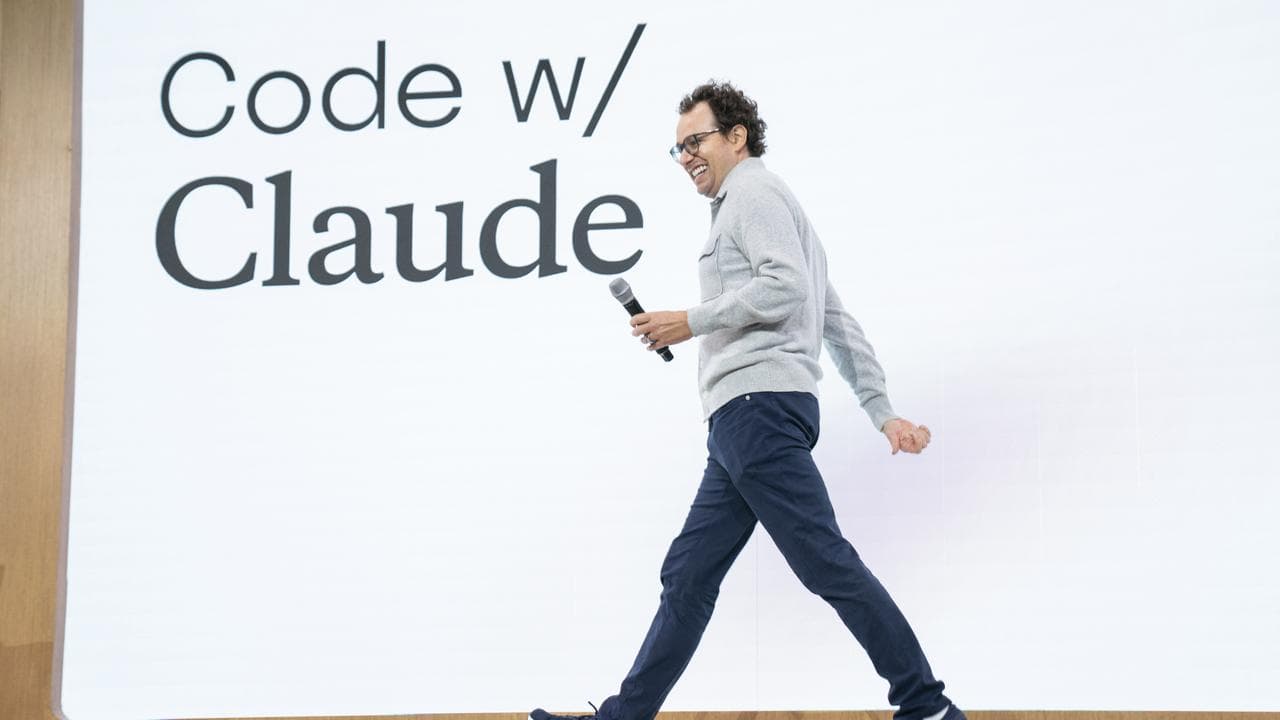
Some current and prospective investors are valuing Anthropic at about $US1.5 trillion, down from roughly $US2 trillion a week ago, after the AI startup disclosed some financial details at a recent investor event, Reuters reported.
The filing confirmed a series of Reuters exclusives that offered an early peek at its contents before Anthropic made it public including details of its financial performance, growth trajectory and IPO plans.
Anthropic will trade on the Nasdaq after the IPO closes under the ticker symbol "ANT".
The IPO comes as Anthropic's own research raises concerns about advanced AI systems, which in controlled tests have demonstrated behaviours including code sabotage, fraud assistance and information manipulation.
Those findings have fuelled concerns about how companies can keep increasingly powerful AI systems under control as they race to deploy them commercially.
Anthropic CEO Dario Amodei has called on the global AI community to slow the release of new capabilities to address those risks.
The company has since rolled out its Opus 5.5 model, seeking to keep pace with ChatGPT maker OpenAI after the launch of the GPT-6 Astra model.
The prospectus highlights risks associated with its AI models, which it said could exhibit "self-preserving behaviours" including attempts to "resist shutdown," to "conceal or manipulate information" and behaviour "resembling blackmail".
Anthropic, founded in 2021 by a team of researchers, was valued at $US965 billion in May in a funding round that drew some of the biggest names in Silicon Valley and Wall Street.
Amazon and Google were among Anthropic's early strategic partners, investing billions of dollars in the startup while providing the cloud infrastructure needed to train and deploy Claude models.
"We believe this abundance of AI will rapidly transform every sector of the global economy in ways greater than the impact of industrialisation, electricity, semiconductors and the internet," Anthropic said in its prospectus.
Anthropic remains locked in a fierce battle with OpenAI to lead the race to build the most advanced AI systems.
The ChatGPT maker confidentially filed for an IPO in June and is expected to list by early 2027.
OpenAI chief executive Sam Altman said in September the company would not go public this year, citing AI safety concerns and describing even a 10 per cent risk of AI causing human extinction by the end of the decade as "unacceptable".
Anthropic's IPO follows that of Elon Musk's SpaceX, which rewrote the IPO record books in June, when it priced a $US75 billion offering that valued the company at $US1.75 trillion.
Goldman Sachs and Morgan Stanley are leading a syndicate of Wall Street banks tapped to underwrite the offering.
with AP


