All four big banks are warning borrowers to brace for an interest rate hike after core inflation jumped above the Reserve Bank's forecasts.
Economists at Westpac and ANZ on Wednesday dropped their calls for the RBA to stay on hold in February after the central bank's preferred measure of inflation - the quarterly trimmed mean - came in at 0.9 per cent in December.
That put growth in the measure - which strips out volatile items and gives a more reliable read on underlying price growth - at 3.4 per cent through 2025, above the RBA's latest forecast of 3.2 per cent.
In September, the quarterly trimmed mean came in at three per cent.
Given recent labour market and household spending data has also been running hotter than expected, the upside surprise on inflation will heighten fears of a rate hike at the central bank's first meeting of the year next Tuesday.
"We think the RBA will conclude that demand is running ahead of supply and that an interest rate adjustment would help ensure inflation returns to the target," ANZ head of Australian economics Adam Boyton said.
Westpac chief economist Luci Ellis also expects a February rate rise, but does not think it will be followed with further hikes.
"Nobody doubted that a cash rate in the fours last year was restrictive and the amount of disinflation required from here is not large," she said.
"Expect a ‘wait-and-see’ stance, with a clear willingness to follow up to be communicated following the meeting."
A 25 basis point hike would add about $90 in monthly repayments for an owner-occupier with a $600,000 mortgage.
Treasurer Jim Chalmers said the rise in inflation was unsurprising as he brushed off criticism government spending was contributing to price pressures.
"The Reserve Bank hasn't been highlighting public spending as a factor in their decisions, not in their public statements, not privately as well," he told reporters in Brisbane.
"In fact, the Reserve Bank downgraded their outlook for public demand twice, in August and again in November last year."
With inflation well and truly outside of the RBA's two-to-three per cent target band, it was a matter of when, not if, the first rate hike comes, VanEck head of investments and capital markets Russell Chesler said.
Before the inflation release, traders were pricing in the chance of a February rate hike at about 60 per cent, after a drop in the unemployment rate heightened the RBA's fears about a lack of spare capacity in the labour market.
Immediately following the release, market-implied odds of a rate hike climbed to more than 70 per cent, senior investment strategist at Global X Marc Jocum said.
Mr Jocum believed a hawkish hold remained the most likely scenario for February, "but the risks around that call are clearly skewed and mounting toward a rate hike".
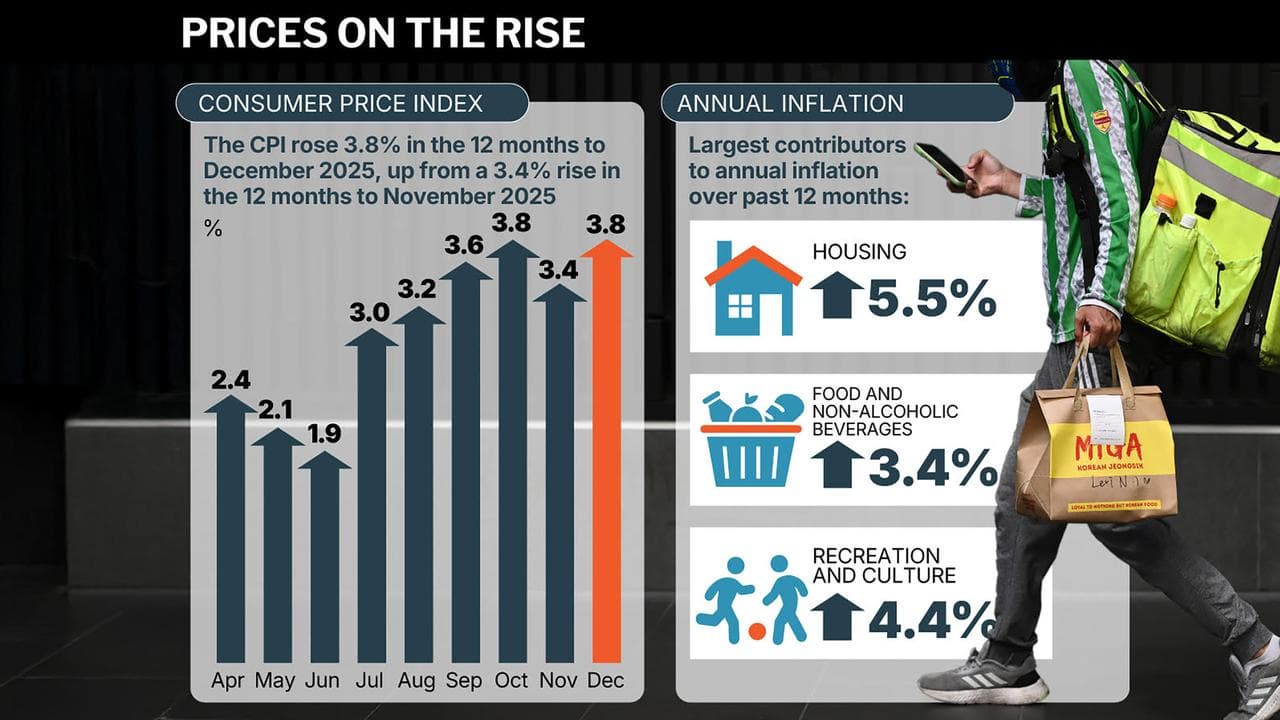
Headline inflation rose 3.8 per cent over the year, up from 3.4 per cent in November.
The rise in the CPI was driven by housing, up 5.5 per cent, followed by food and non-alcoholic beverages, up 3.4 per cent, and recreation and culture, which rose 4.4 per cent, the Australian Bureau of Statistics said.

Electricity costs rose 21.5 per cent in the 12 months to December, largely because of state electricity rebates in Queensland and WA being used up by households.
Minutes from the RBA's last rates meeting in December showed board members were still uncertain whether the resurgence in inflation was driven by temporary or more persistent pressures.
Wednesday's release will heighten concerns price pressures are more entrenched and will not go away with interest rates at current levels.


